Skip to content

Special Educational Needs and/or Disabilities (SEND)

For information on how we support pupils with special educational needs and/or disabilities (SEND), please click on the link below:


SEND REPORT 

SEND Information Report September 2025-26


At Orchard Primary School we support all pupils with Special Educational/Disability Needs (SEND) to ensure they make progress and achieve their potential.  Children have learning difficulties for a variety of reasons and here at Orchard Primary we ensure that we take responsibility for identifying and providing appropriate provision for all special educational needs.


What types of SEND do we provide for?

As an inclusive mainstream school, special educational needs and provision are provided under the following headings:

Communication and Interaction this includes children with speech and language delay, impairments or disorders, specific learning difficulties such as dyslexia, dyscalculia, dysgraphia, and dyspraxia, hearing impairment and those who demonstrate features with the autistic spectrum.

Cognition and Learning this includes children who demonstrate features of moderate, severe or profound learning difficulties or specific learning difficulties such as dyslexia, dyscalculia, dysgraphia or dyspraxia.

Social, Mental and Emotional Health - this includes children who may be withdrawn or isolated, disruptive or disturbing, hyperactive or lack concentration.

Sensory and/or Physical Needs this includes children with sensory, multi-sensory and physical difficulties.


Who is our Special Educational Needs Coordinator (SENDCo) and how can he/she be contacted?

Our SENDCo is Mrs Sarah Bitcon; she can be contacted through the school.


Orchard Primary School

Pershore

Worcs

WR10 1ET

Tel:      01386 552515, Email:  office@orchardprimary.org.uk

The Governor responsible for SEND is Mrs Beth Seale and she can be contacted via the School Office.

Admission arrangements for pupils with SEND.

Children with SEND are admitted to school in accordance with our whole school admissions policy.

No pupil will be refused admission to school on the basis of his or her special educational need.  In line with the SEN and Disability Act we will not discriminate against disabled children and we will take all reasonable steps to provide effective educational provision.

How do we identify and assess pupils with SEND?

At Orchard Primary School we identify children with SEND as early as possible.  This is achieved through regular contact with our feeder Early Years settings and by regular monitoring and assessment throughout the school year.


“Triggers” for intervention may include one or more of the following:

  • BASE (EYFS online assessment) scores indicating poor early learning skills at the start and end of Foundation Stage.
  • On-going teacher and TA observation and assessment within the classroom.
  • Assessments in KS1 and KS2 showing how far below national expectation the child is working.
  • Lower than expected scores through our standardised assessments.
  • Emotional and behavioural difficulties persisting in spite of the use of the school’s behaviour management programmes.
  • Diagnosis of a previously unidentified medical condition or other need.
  • Looked After Children.
  • Information from a previous school that additional intervention has been in place.
  • Parental concerns.
  • Child’s own views.

What is our approach to teaching pupils with SEND?

  • Any pupil falling outside the range of expected academic achievement will be monitored.
  • The class teacher will provide differentiated learning opportunities and quality first teaching that will aid the pupil’s academic progression and enable the teacher to better understand the provision and teaching style that needs to be applied.
  • Support staff, under the direction of the class teacher, can adapt planning to support the needs of a child where necessary.
  • Specific resources and strategies will be used to support the child individually and in groups based on observations and assessment that has taken place.
  • Parents will be informed of any concerns and the action the school is taking.  Parents are encouraged to share information and knowledge with the school via the class teacher or through discussion with the SENCO.
  • Pupils are placed on the SEND register once the need is confirmed and often once an outside agency is involved in supporting the learner.

How do we adapt the curriculum and learning environment for pupils with SEND?

  • We carefully consider the needs of each child and then ensure that equipment used is accessible.  Key words, visual timetables and literacy and maths resources are used across the school to support learning as appropriate.
  • Differentiation of the curriculum to match tasks to ability.
  • Use of a range of teaching styles which recognise the individual learning styles of the children in the class.
  • Use of TAs to provide additional support within lessons.
  • Homogenous teaching groups in phonics
  • Small group and 1:1 teaching by SEND staff.
  • Accessibility to resources to support pupils with sensory and/or physical difficulties.

How accessible is the school environment?

  • We have an Accessibility Policy, a copy of which is available on the school website.
  • The school has excellent facilities for non-ambulant children, including disabled toilets, shower, ramps, widened doorways and general wheelchair access throughout.

What additional support for learning is available to pupils with SEND?

  • Additional help may be offered through interventions delivered in small groups, pairs or 1:1.
  • An IPP (Individual Provision Plan) will be planned by the class teacher to suit the pupil’s individual needs.
  • Specialist support provided by outside agencies, eg Speech and Language Therapy, Behaviour Support, Educational Psychologist, Behavioural Optometry Assessment and Chadsgrove Special School.

How do we enable pupils with SEND to engage in activities with other pupils who do not have SEND?

  • All children are included in all parts of the school curriculum and we aim for all children to be included on school visits.  We will provide the necessary support to ensure that this is successful and may discuss this in advance with parents. It might be appropriate for a parent/carer to accompany their child on a school visit.
  • Our Midday Supervisors and TAs support the children during lunchtimes and playtimes.

How do we consult parents of pupils with SEND and involve them in their child’s education?

At Orchard Primary School we value the importance of building positive relationships with parents and families within our School community. Where a pupil is identified as needing additional support, parents are given the opportunity to be part of the assessment and review process.  Other support available includes:

  • Initial visits to school.
  • Introductory meetings with the SENCo and Class Teacher.
  • Meeting with the SENCo to discuss children’s progress.
  • Family targets on the Individual Provision Plan (IPP).
  • Parent/Carer and teacher meetings including update from professionals.
  • Annual Review meeting and report.
  • Involvement of parents in changes in school through informal and formal consultations.
  • Informing parents of any concerns and the action the school is taking.  Parents are encouraged to share information and knowledge with the school.

How do we consult pupils with SEND and involve them in their education?

  • Children who have IPPs discuss their progress and targets when these are reviewed.  If your child has an EHCP, their views will be sought before any review meetings.
  • Children are routinely asked to reflect on their learning and share how they feel they are making progress.

How do we assess and review pupils’ progress towards their outcomes?

  • Regular pupil progress meetings are held with the class teacher and SENCo and are used to monitor and assess the progress being made by the pupil.
  • Half termly class provision maps are used to identify specific interventions and their impact is evaluated with the SENDCo and class team.

How do we support pupils moving between different phases of education?

We recognise that transitions can be difficult for a child with SEND, and we take steps to ensure that any transition is a smooth as possible.

If a child is joining us from another school/setting:

  • The SENCo/Class Teacher will liaise virtually with pre-schools when appropriate.
  • If the child would be helped by a book/passport to support them in transition, then one will be made for them. Virtual tours/meet the teacher meetings online to support transition.
  • The child will be able to visit our school after school hours in order to support transition.

When moving classes in school:

  • Information will be passed on to the new class teacher in advance and in most cases a planning meeting will take place with the new teacher. IPPs will be shared with the new teacher.
  • Transition activities appropriate to the child will be planned.
  • If your child would be helped by a book/passport to support them in transition, then one will be made for them

If the child is moving to another school:

  • We will contact the school SENCo and ensure he/she knows about any special arrangements or support that need to be made for the child. Where possible, a planning meeting will take place with the SENCo virtually from the new school.
  • We will make sure that all records about the child are passed on as soon as possible.
  • If the child would be helped by a book/passport to support them in transition, then one will be made for them.

How do we support pupils with SEND to improve their emotional and social development?

We recognise that some children have extra emotional and social needs that need to be developed and nurtured.  All classes follow a structured PSHE curriculum to support this development.  However, for those children who find aspects of this difficult we offer.

  • Social awareness games and activities.
  • Social stories.
  • Referral to CAHMS (Child and Adolescence Mental Health Service).
  • Referral to Behaviour Support.
  • Referral to Reach for Wellbeing
  • Support from Family Support Worker.
  • Speech and Language Therapy.
  • ELSA sessions.

What expertise and training do our staff have to support pupils with SEND?

  • Within school we have a culture of sharing good practice and expertise; this enables us to ensure our staff have as much knowledge as possible in supporting children with SEND.
  • We are part of the Chadsgrove Teaching Alliance. Regular briefings provide an update on new local and national SEN information.
  • Our SENCo has completed the NASEN Award.
  • The school provides training and support to enable all staff to improve the teaching and learning of children, including those with SEND. This includes whole school training on SEND issues, such as Autism and attachment.
  • We work closely with our school SALT, and the SENCo liaises with her to support the speech and communication needs of our learners.

How will we secure specialist expertise?

As a school we work closely with any external agencies that we feel are relevant to supporting individual children’s needs, eg Behaviour Support, School Nursing Team, CAMHS, Paediatricians, Speech and Language Teachers, Educational Psychologists, Family Support Workers, Behavioural Optometry Assessments and Specialist Learning Support Teams such as Chadsgrove.

How will we secure equipment and facilities to support pupils with SEND?

The school budget includes money for supporting children with SEND.  The Head Teacher decides on the budget for SEND in consultation with the School’s Governing Body on the basis of needs in the school.

Where the needs of a pupil are significant and more complex, school would then consider requesting additional support through “Top Up Funding” from the Local Authority.

The school identifies all support given within school and this is reviewed regularly and changes made as needed, so that the needs of children are met, and resources are deployed as effectively as possible.

How do we involve other organisations in meeting the needs of pupils with SEND and supporting their families?

As a school we work closely with any external agencies that we believe are relevant to supporting individual children’s needs within our school, including Health Services (GPs, School Nurse), CAMHS (Child and Adolescent Mental Health Service), Paediatricians, Speech and Language Therapists, Psychologists and Children’s Services (Early Help Teams, Social Workers, specialist advisory teachers).

How do we evaluate the effectiveness of our SEND provision?

  • Classroom observation (SENCo, Head Teacher, SEND Governor).
  • Work sampling (SENCo, Head Teacher).
  • Scrutiny of planning (Head Teacher, SENCo).
  • Information feedback from all staff.
  • Pupil interview.
  • Pupil Tracking (Head Teacher, SENCo).
  • Pupil review meetings and records of review meetings.
  • Monitoring of IPPs and IPP targets and Pastoral Support Programmes.
  • Attendance records.
  • Class provision mapping

Contact details of support services for the parents of pupils with SEND:

Worcestershire SEN Support Services – https://www.worcestershire.gov.uk/council-services/schools-education-and-learning/send-local-offer/all-age-disability-0-25-years-service-send/send-services  – Schools – Special Educational Needs and Disabilities

Tel: 01905 845579


SENDIASS (SEND Information Advice and Support Service) Worcestershire.

Tel: 01905 768153

Who can young people and parents contact if they have concerns?

  • Please speak to the class teacher in the first instance.
  • Further information is available from our SENDCo, Mrs Sarah Bitcon.

How do we handle complaints from parents of children with SEND about provision made at the school?

Complaints about the provision or organization of SEND will be dealt with through the procedures outlined in the whole school Complaints Policy.

Where can the LA’s Local Offer be found?

https://www.worcestershire.gov.uk/council-services/schools-education-and-learning/send-local-offer

A link to Worcestershire County Council’s Local Offer for SEND can be found on our school website.


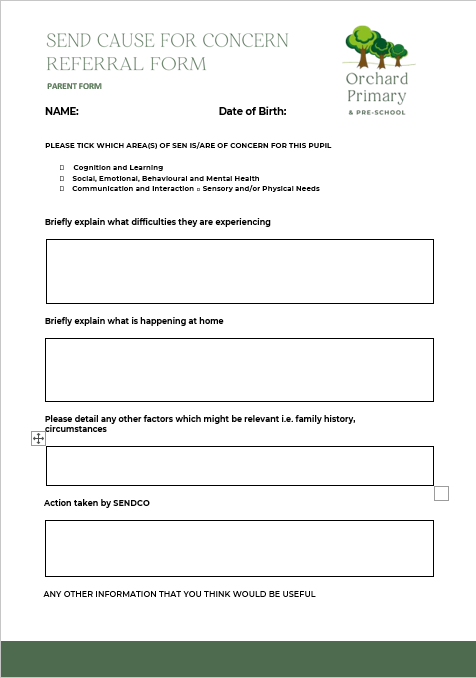
REFERRAL FORM