Orchard Primary and Pre-School
Oracy- Voice 21

We are proud to be a Voice 21 Oracy School
We’re delighted to announce that Orchard Primary is now a Voice 21 Oracy School. This means we place speaking a
nd listening at the heart of everything we do so every pupil leaves Orchard able to communicate with confidence, clarity and kindness.
Why this matters
-
Oracy builds confidence, strengthens reading and writing, and helps pupils organise and explain their thinking.
-
Being part of the Voice 21 network gives our staff practical training, classroom routines and resources to teach oracy well across every year group.
What parents will see
-
Talk‑rich lessons, clear sentence stems and structured discussion tasks in everyday lessons.
-
Pupils taking on oracy roles (presenters, talk partners, ambassadors) and regular opportunities to practise leadership and teamwork.
-
A focus on vocabulary, listening and effective talk that supports learning across the curriculum.
This complements our school values — Aspiration, Collaboration, Respect, Responsibility and Kindness — and our school improvement priority of Building Confidence, Engagement and Oracy. We’re excited by the difference this will make to pupils’ learning, wellbeing and readiness for the next stage of their education.
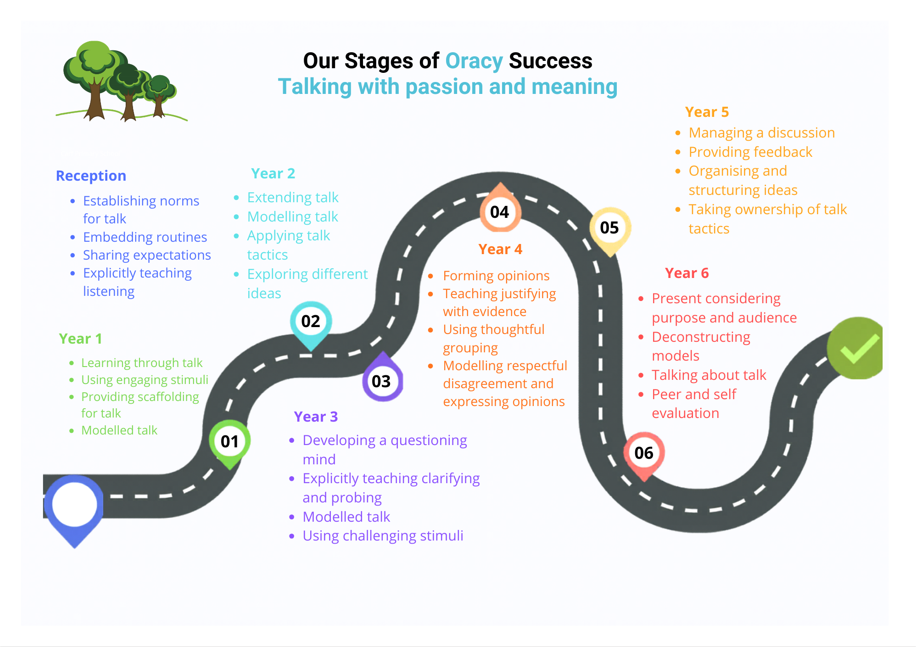
Our INTENT
At Orchard Primary we believe every pupil has the right to be successful. Our oracy curriculum, delivered through Voice 21’s approaches, ensures pupils become confident, fluent and respectful communicators who can use talk to learn, think and lead. Oracy at Orchard develops the language, vocabulary and listening skills pupils need to access the full curriculum, to express ideas clearly, and to show the aspiration, collaboration, respect, responsibility and kindness that underpin school life.
Three focused purposes
- Equip pupils with the spoken‑language skills to learn: pupils will use structured talk to rehearse, reason and deepen subject knowledge so oracy becomes a tool for thinking and retrieval across reading, writing, maths and wider curriculum subjects.
- Build confident, resilient communicators: pupils will gain the confidence to speak for different purposes (explain, persuade, discuss, perform) and audiences, including leadership roles such as oracy ambassadors.
- Include and accelerate the vulnerable: oracy teaching will narrow gaps for pupils with SLCN, SEND and disadvantage through targeted routines, vocabulary instruction and appropriate AAC/non‑verbal supports.
At HOME
How parents can help with oracy at Orchard Primary
At Orchard Primary we put speaking and listening at the heart of learning. You can make a big difference to your child’s confidence and school progress by building simple oracy habits at home. Here are easy, practical things parents can do.
Everyday conversation
- Ask open questions that need more than “yes/no” answers (e.g. “What was the best part of your day and why?”).
- Give your child time to think — pause for a few seconds after a question so they can organise a full answer.
Build vocabulary naturally
- Introduce and reuse subject words (e.g. “fraction”, “habitat”, “opinion”) in everyday talk and praise their use.
- When your child uses a new word, ask them to explain it or give an example to deepen understanding.
Storytelling and explanation
- Encourage your child to retell a story, describe a picture or explain how they solved a problem.
- Use prompts: beginning, middle, end; “Tell me what happened first” or “Why did that happen?”
Practice short presentations
- Give them small audiences: let them present a project, read aloud, or teach a family member something new.
- Keep it short and supportive — focus on one thing to improve each time (clear voice, good sentence, eye contact).
Playful talking routines
- Try “Talk Time” for 5–10 minutes (news from school, a book summary, a favourite fact).
- Play games that build speaking skills: storytelling rounds, “question only” debates, or explain-your-choice games.
Support listening skills
- Model good listening: face them, show interest, ask a follow-up question and paraphrase what they said.
- Practice listening games (spot the sound, memory of a short story) to boost attention and sequencing.
Link to reading and writing
- After reading, ask your child to describe the characters’ feelings, predict what happens next or explain a favourite part.
- Encourage them to say a sentence aloud before writing it — this helps planning and handwriting fluency.
Help with confidence and resilience
- Praise effort: “You explained that clearly — I liked how you used that word.”
- Normalise mistakes: encourage trying again and rehearsing different ways to say something.
Supporting younger children and SEND
- For Reception and KS1, use simple, repeated phrases, songs and rhymes to build vocabulary and listening.
- If your child has additional communication needs, use visual supports, gestures and short, clear sentences — talk to us about home strategies matched to school approaches.
Quick checklist for parents
- One open question a day.
- One short storytelling or explanation activity a week.
- Read together daily and ask your child to summarise one part aloud.
- Celebrate small improvements.
Why this matters
Talking helps children think, improves reading and writing, builds confidence and supports wellbeing. Your daily conversations are as important as school lessons in helping your child find their voice.
Our JOURNEY